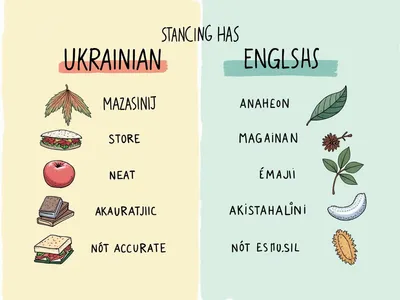
What are the most challenging false friends in Ukrainian for English speakers
The most challenging false friends in Ukrainian for English speakers are words that look or sound similar to English words but have different meanings, often causing confusion. Some of the key false friends include:
- Магазин: Means “store” or “shop” in Ukrainian, not “magazine.” The Ukrainian word for “magazine” is журнал.
- Акуратний: Means “neat” or “tidy,” not “accurate.” For accurate, use точний.
- Актуальний: Means “relevant” or “current,” not “actually” (which is насправді).
- Екзамен: Means “exam” or “test,” not “examine” (which is досліджувати or обстежувати).
- Батон: Refers to a type of white bread, not a baton or stick.
- Кабінет: Means “office” or “study,” not a cabinet (шкафа is the word for cabinet).
- Роман: Means “novel,” not “Roman” as in ancient Roman.
- Інсульт: Means “stroke” (medical), not “insult” (образа).
- Інтелігентний: Means “cultured” or “refined,” not “intelligent.”
- Прескрипція: Means “official decree,” not “prescription” for medicine (written order for medication).
These false friends are tricky because their spellings and sounds closely resemble English words, but the meanings differ significantly, leading to misunderstandings for learners. Awareness of these false friends improves communication and avoids awkward mistakes when speaking or translating between Ukrainian and English.
Why False Friends are Particularly Challenging in Ukrainian
False friends exist in many language pairs, but Ukrainian-English false friends represent a unique challenge because of the shared use of the Cyrillic and Latin alphabets in learners’ minds. English speakers often rely on familiar Latin-root cognates or borrowed words, only to find that Ukrainian has adopted the same root with a different meaning or shifted usage. This leads to overconfidence or hesitation when choosing vocabulary. For example, seeing “актуальний” may tempt learners to interpret it as “actually,” but its meaning is closer to “current” or “relevant,” which requires adjustment.
Furthermore, false friends in Ukrainian tend to be common everyday words rather than obscure vocabulary, so errors happen frequently in practical conversation or reading. Situations such as shopping (магазин), discussing literature (роман), or talking about medicine (інсульт) can cause significant miscommunication unless these differences are well understood.
Strategies to Master Ukrainian False Friends
Recognizing false friends as a category of vocabulary is the first step to overcoming confusion. The following practical strategies can help learners internalize distinctions between false friends and their actual English counterparts:
- Contextual Learning: Practice these words within realistic phrases or dialogues to develop intuition about their proper meanings. For instance, link “магазин” with “buying groceries” and “журнал” with “reading articles.”
- Mnemonic Devices: Create mental associations that highlight the differences. For example, recall “інсульт” is a serious medical condition (stroke), which should not be confused with a verbal insult.
- Contrastive Lists: Maintain a personal vocabulary journal with side-by-side pairs (false friend / correct translation) to review regularly.
- Use Authentic Materials: Reading Ukrainian news, literature, or watching films helps see how false friends function naturally.
- Ask Native Speakers: When possible, verify tricky words with a native Ukrainian speaker to cement correct usage.
Detailed Examples and Common Pitfalls
Магазин vs Журнал
A typical mistake occurs when English speakers assume “магазин” means “magazine” due to phonetic similarity. Ordering “магазин” in a Ukrainian café or asking for a “магазин” expecting a magazine will lead to confusion or laughter because it means “store.” Always remember “журнал” is the accurate term for “magazine,” and it is a good word to practice with different genres such as “журнал мод” (fashion magazine).
Акуратний vs Точний
The adjective “акуратний” might appear to mean “accurate,” but it actually conveys neatness or tidiness. When a Ukrainian says, “Він акуратний студент,” they mean “He is a tidy student,” not necessarily precise or correct. In contrast, “точний” means exact or precise, relating to accuracy, so care must be taken to pick the right word depending on the intended meaning.
Інтелігентний vs Інтелігент
The word “інтелігентний” means cultured or refined rather than intelligent. It describes someone with good manners, education, and social grace, akin to a polite intellectual or a refined person. Mistaking it for “intelligent” may lead to misunderstandings about someone’s mental capabilities. The straightforward word for “intelligent” in Ukrainian is “розумний.”
Батон: Bread, Not Baton
“Батон” is another tricky one that literally means a long loaf of white bread, similar to a baguette or sub-style bread. Ukrainian speakers will not understand it as a baton or a stick object. This distinction arises because English “baton” is used in contexts like sports or music, but in Ukrainian, it’s mostly culinary. Confusing it with an object can result in humorous errors.
Інсульт vs Insult
One of the most serious false friends is “інсульт,” meaning a medical stroke affecting the brain. English speakers must not confuse it with “insult.” Saying “він отримав інсульт” (“he had a stroke”) instead of implying offense requires care, especially in medical or emergency contexts.
Summary of Common Misconceptions
| Ukrainian Word | False English Assumption | Actual Meaning | Notes |
|---|---|---|---|
| Магазин | Magazine | Store/shop | Use журнал for magazine |
| Акуратний | Accurate | Neat, tidy | Use точний for accurate |
| Актуальний | Actually | Relevant, current | Use насправді for actually |
| Екзамен | Examine | Exam, test | Use досліджувати for examine |
| Батон | Baton (stick) | White bread loaf | Culinary term |
| Кабінет | Cabinet | Office, study room | Use шафа for cabinet |
| Роман | Roman (ancient) | Novel | Literary term |
| Інсульт | Insult | Stroke (medical) | Serious condition |
| Інтелігентний | Intelligent | Cultured, refined | Personality trait |
| Прескрипція | Prescription | Official decree | Use рецепт for medical prescription |
This table reflects frequent pitfalls for learners and serves as a quick reference during study or translation.
Conclusion
False friends in Ukrainian represent a significant but manageable hurdle for English speakers learning the language. They exemplify how similar words can mask important semantic differences, requiring learners to develop careful vocabulary awareness and contextual understanding. By focusing on practical usage, reinforcing correct meanings, and revisiting mistakes, learners can minimize confusion and enhance their Ukrainian fluency. This mastery not only prevents awkward miscommunications but also deepens cultural and linguistic competence.