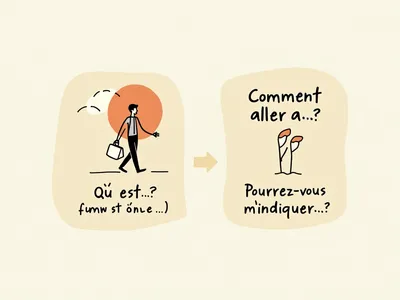
What are some common phrases to ask for directions in French
Phrases courantes pour demander son chemin en français
Pour demander son chemin en français, les formules les plus utiles sont « Où est… ? », « Comment puis-je aller à… ? », « Pouvez-vous m’aider ? » et « Pouvez-vous m’indiquer le chemin pour… ? ». Dans la rue, une demande polie et courte fonctionne souvent mieux qu’une phrase longue, surtout si la personne doit répondre vite.
Here are some common phrases to ask for directions in French:
- Excusez-moi, pourriez-vous m’aider ? (Excuse me, could you help me?)
- Où est…? (Where is…?)
- Comment puis-je aller à…? (How can I get to…?)
- Pouvez-vous me montrer sur la carte ? (Can you show me on the map?)
- Je cherche… (I’m looking for…)
- Quelle est la direction pour…? (What is the direction for…?)
- Est-ce loin d’ici ? (Is it far from here?)
- Y a-t-il un(e)… près d’ici ? (Is there a… near here?)
- Pour aller à…, s’il vous plaît ? (To go to…, please?)
- Pouvez-vous m’indiquer le chemin pour…? (Can you point me in the direction of…?)
These phrases cover the most common situations: finding a station, a museum, a hotel, a pharmacy, or a street address. In real conversation, the blank is usually filled with a place name or landmark: Où est la gare ?, Comment puis-je aller au musée ?, or Y a-t-il une pharmacie près d’ici ?
Phrases supplémentaires très utiles
When directions are spoken, the answer often includes distance, walking time, or a transport option. These phrases make that exchange smoother:
- Pouvez-vous répéter, s’il vous plaît ? (Can you repeat, please?)
- Je ne comprends pas. (I don’t understand.)
- Est-ce que c’est loin ? (Is it far?)
- Combien de temps cela prend-il à pied ? (How long does it take on foot?)
- Est-ce que je peux y aller en bus/métro ? (Can I get there by bus/metro?)
- Je suis perdu(e). (I’m lost.)
A very practical phrase for city travel is « à pied », which means “on foot.” If someone says « dix minutes à pied », the destination is about a 10-minute walk away. If they say « prenez le métro », they are recommending the subway rather than walking.
How to start the question politely
In French, a short greeting before the question makes the exchange sound natural and respectful. « Bonjour » is the safest all-purpose opening during the day, while « Excusez-moi » is useful when interrupting someone in the street, in a station, or in a shop.
A simple, natural pattern is:
- Bonjour, excusez-moi, où est la gare ?
- Excusez-moi, pouvez-vous m’indiquer le chemin pour le centre-ville ?
- Bonjour, comment puis-je aller au musée ?
Politeness matters especially with strangers, and it is common to hear vous rather than tu in this kind of exchange. Vous is the formal or neutral “you” used with people not personally known.
Useful vocabulary inside direction questions
A few words appear again and again in direction requests:
- où = where
- comment = how
- aller = to go
- chemin = path/way
- direction = direction
- loin = far
- près de = near
- carte = map
- a pied = on foot
- bus = bus
- métro = subway
Knowing these words makes it easier to understand answers as well. For example, « près de la station » means “near the station,” and « tout droit » means “straight ahead,” a very common instruction in spoken French.
Common reply words to listen for
Directions in French often use a small set of high-frequency location words. These are worth recognizing because they appear in almost every route explanation:
- tout droit = straight ahead
- à droite = to the right
- à gauche = to the left
- au coin = at the corner
- en face de = opposite / across from
- près de = near
- loin de = far from
- à côté de = next to
- après = after
- avant = before
A full reply might sound like: « Allez tout droit, puis tournez à gauche. C’est à côté de la banque. » That means: “Go straight, then turn left. It’s next to the bank.” Learning these route words is often more valuable than memorizing a long grammar explanation, because real conversations depend on listening for them quickly.
Common mistakes to avoid
One frequent mistake is translating English word order too literally. « Où est la station ? » is natural and simple, while a direct word-for-word translation of “Can you tell me where the station is?” can sound more complicated than necessary in basic conversation.
Another common issue is forgetting the polite form. « Pouvez-vous… ? » is usually safer than a bare command like « Montrez-moi… ». In everyday French, softening the request with s’il vous plaît or excusez-moi makes the phrase friendlier and more idiomatic.
Pronunciation also matters because some short French words are easy to miss in noisy places. Où and où est should be pronounced clearly, and s’il vous plaît is often said as one smooth unit. Clear, repeated speaking practice helps these phrases become automatic, especially for learners preparing for real-life interactions.
A simple formula for asking directions
A reliable speaking pattern is:
Greeting + polite opener + question + place name
Examples:
- Bonjour, excusez-moi, où est la poste ?
- Excusez-moi, comment puis-je aller à la gare ?
- Bonjour, pouvez-vous m’indiquer le chemin pour le centre-ville ?
This structure works in most everyday situations and keeps the request concise. It is especially helpful when asking strangers, staff, or passersby, because it makes the question easy to understand and easy to answer.
Mini FAQ
What is the most useful phrase for asking directions in French?
« Excusez-moi, où est… ? » is one of the simplest and most useful forms. It is short, polite, and easy to adapt to any location.
How do I ask if something is far away?
Use « Est-ce loin d’ici ? » or « Est-ce que c’est loin ? ». Both ask whether the place is far.
How do I ask for directions on a map?
Use « Pouvez-vous me montrer sur la carte ? ». This is especially useful when the route is complicated.
How do I say I am lost?
Say « Je suis perdu(e). » The ending changes according to gender in writing, but in speech the phrase is commonly understood in both forms.
What should I listen for in the answer?
The most important words are tout droit, à droite, à gauche, près de, en face de, and à côté de. These words usually carry the core of the directions.
French direction phrases are small, practical, and highly reusable. A learner who can say « Bonjour, excusez-moi, où est… ? » and understand « tout droit » or « à gauche » already has the basic tools needed for everyday navigation in French-speaking places.
References
-
How to Ask for Directions in French: Key Phrases for Students
-
Ask and Give Directions in French: Feel like a Native Speaker