What are the most challenging false friends in Ukrainian for English speakers
What are the most challenging false friends in Ukrainian for English speakers
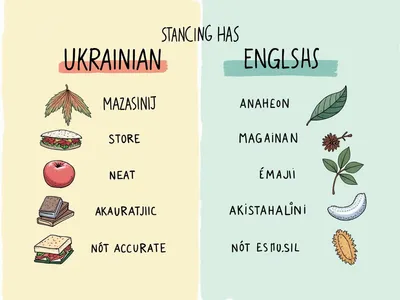
The most challenging false friends in Ukrainian for English speakers are words that look or sound familiar but mean something different, especially in everyday conversation where a single mistaken word can change the message completely. The hardest ones are usually the words that seem “obvious” at first glance: магазин is not “magazine,” кабінет is not a “cabinet,” and актуальний is not “actual.”
These false friends matter because Ukrainian often borrows international-looking forms, but the meaning may have shifted. In speaking, that can create awkward misunderstandings; in reading, it can make a sentence seem clearer than it really is. Active conversation practice helps expose these traps faster than passive memorization, because the wrong word becomes obvious in a real context.
The most challenging false friends in Ukrainian
- Магазин: Means “store” or “shop” in Ukrainian, not “magazine.” The Ukrainian word for “magazine” is журнал.
- Акуратний: Means “neat” or “tidy,” not “accurate.” For accurate, use точний.
- Актуальний: Means “relevant” or “current,” not “actually” (which is насправді).
- Екзамен: Means “exam” or “test,” not “examine” (which is досліджувати or обстежувати).
- Батон: Refers to a type of white bread, not a baton or stick.
- Кабінет: Means “office” or “study,” not a cabinet (шкафа is the word for cabinet).
- Роман: Means “novel,” not “Roman” as in ancient Roman.
- Інсульт: Means “stroke” (medical), not “insult” (образа).
- Інтелігентний: Means “cultured” or “refined,” not “intelligent.”
- Прескрипція: Means “official decree,” not “prescription” for medicine (written order for medication).
Why these false friends are so tricky
The difficulty is not just that the words resemble English. It is that several of them belong to the kind of vocabulary learners expect to be “safe”: everyday nouns, school words, and common adjectives. That makes errors more likely than with rare or technical terms.
A false friend is especially dangerous when the Ukrainian word feels internationally recognizable. For example, інтелігентний looks close to “intelligent,” but the real meaning is closer to “well-mannered” or “cultured.” In conversation, saying that someone is інтелігентний does not simply mean they are smart; it suggests social refinement and education. Likewise, актуальний often means something like “current” or “topical,” so it is useful in news, work, and discussion, but not as a substitute for “actually.”
The biggest traps by meaning
1. Everyday places and objects
Words for places and objects cause some of the most frequent mix-ups because they appear in basic conversations.
- Магазин is a shop, so a sentence like Я йду в магазин means “I’m going to the store.”
- Кабінет usually means an office or study, so кабінет директора is the director’s office, not a piece of furniture.
- Батон is a loaf of white bread, often a long one sold in supermarkets and bakeries.
These are easy to misread because English speakers often associate the form with a near-identical English noun and then guess too quickly.
2. Academic and formal vocabulary
Formal words can be even more misleading because they appear in school, media, and paperwork.
- Екзамен means an exam or test.
- Прескрипція is an official decree or prescription-like legal order in some contexts, not the ordinary medical “prescription” most English speakers expect.
- Актуальний is used for current issues, relevant questions, and topical topics.
A learner may recognize the shape of the word and still miss the real usage. In Ukrainian, meaning is often secured by context, so these words should be learned in short phrases, not as isolated translations.
3. Words that look “transparent” but are culturally specific
Some false friends do not just differ in dictionary meaning; they differ in how naturally they sound.
- Інтелігентний is tied to the Ukrainian and broader East Slavic idea of an educated, polite, intellectually formed person.
- Роман means a novel, so it belongs in literary discussion, bookstore talk, and school reading lists.
These words can be especially confusing because English has a related-looking form with a different core meaning. The safest approach is to learn the Ukrainian word with a fixed example sentence.
Quick contrast table
| Ukrainian word | Real meaning | Common wrong guess |
|---|---|---|
| магазин | store, shop | magazine |
| акуратний | neat, tidy | accurate |
| актуальний | current, relevant | actually |
| екзамен | exam, test | examine |
| батон | white loaf of bread | baton |
| кабінет | office, study | cabinet |
| роман | novel | Roman |
| інсульт | stroke | insult |
| інтелігентний | cultured, refined | intelligent |
| прескрипція | official decree | prescription |
How to avoid false-friend mistakes in real speech
The safest habit is to learn each suspicious word with a full phrase rather than a single translation. For example:
- купити хліб у магазині — to buy bread in a shop
- точний час — exact time
- актуальна тема — a current topic
- складати екзамен — to take an exam
- мати кабінет — to have an office
Full phrases do more than memorized word lists because they show the word’s normal grammar and its natural meaning at the same time. That is one reason spoken practice is so effective: a wrong false friend sounds strange immediately when it is used in a sentence.
A few extra caution points
False friends do not always match only one English word. Sometimes a Ukrainian word may overlap with several English possibilities but still not line up perfectly with any of them. For example, актуальний can mean “relevant,” “current,” or “topical” depending on context, so it should not be flattened into a single English equivalent.
It also helps to remember that some words are not false friends in every context. A similar-looking form may be correct in one sentence and wrong in another, which is why context matters more than surface similarity.
FAQ
Which Ukrainian false friends cause the most mistakes?
The most common problems usually come from магазин, актуальний, кабінет, інтелігентний, and інсульт, because they look highly familiar to English speakers and appear in ordinary conversation.
Are false friends only a beginner problem?
No. Even intermediate learners confuse them, especially when reading quickly or translating mentally. The danger often increases as vocabulary expands, because familiar-looking words encourage guessing instead of checking meaning.
What is the best way to remember them?
The most reliable method is to learn each word with a concrete phrase, such as йти в магазин or актуальна тема, rather than with a single English gloss. Context-based learning makes the meaning easier to retrieve in conversation and reduces automatic mistranslation.