How can I avoid mistakes with false friends when learning Italian
To avoid mistakes with false friends when learning Italian, it is best to treat similar-looking words as possible traps rather than automatic translations. The safest habit is to check meaning in context before using a word, especially when it looks familiar because of English, Spanish, French, or another Romance language.
What false friends are
False friends are words that look or sound similar in two languages but do not mean the same thing. In Italian, they often cause errors because the learner recognizes the shape of the word and assumes the meaning is shared.
A classic example is attualmente, which means “currently” or “at present,” not “actually.” Another is parenti, which means “relatives,” not “parents.” These words are dangerous precisely because they feel easy.
Learn the most common false friends explicitly
The fastest way to reduce mistakes is to learn a small set of high-frequency false friends on purpose. A few especially common Italian examples are:
- attualmente = currently, at present
- eventualmente = possibly, if necessary
- libreria = bookshop, bookstore
- camera = room
- colazione = breakfast
- magazzino = warehouse, storeroom
- pretendere = to demand, to claim
- simpatico = nice, friendly, pleasant
- educato = polite, well-mannered
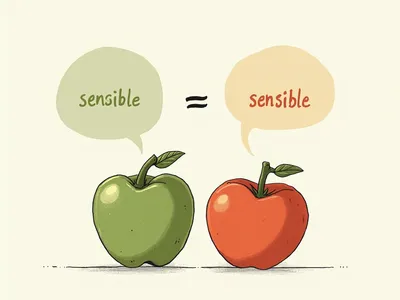
- sensible does not mean “sensible” in the English sense; Italian sensibile means sensitive
Studying these as paired items is more effective than hoping the right meaning will be obvious in the moment.
Use context as a filter
False friends are easier to spot when the surrounding sentence is considered first. In Italian, una camera d’albergo is clearly a hotel room, while la camera dei bambini means the children’s room, not a camera device. In the same way, fare colazione always means to have breakfast, so a phrase like prima di colazione means “before breakfast,” not “before the lunch break.”
Context matters because many false friends are only misleading when seen in isolation. A word that looks familiar may become clear once the topic, grammar, and nearby verbs are checked together.
Build a personal false-friends list
A short notebook or digital list is useful because false friends are often individual problem words. The most effective list is not a long dictionary copy, but a record of the words that have already caused confusion.
A practical format is:
- Italian word
- mistaken meaning that came to mind
- correct meaning
- one example sentence
For example:
- eventualmente
- mistaken meaning: eventually
- correct meaning: possibly / if needed
- example: Eventualmente possiamo cambiare orario.
Reviewing a small list regularly is more effective than trying to memorize every possible trap at once.
Compare, don’t guess
A good rule is to compare suspicious words with a trusted dictionary entry before speaking or writing. Bilingual dictionaries that give usage examples are especially useful, because false friends are often revealed by the kind of sentence they appear in, not just by the translation itself.
This matters most with words that seem transparent but carry a different everyday meaning in Italian. For instance, assistente is not always “assistant” in the broad English sense; in some contexts it can refer to a teaching or medical role. The exact meaning depends on the setting.
Train with real Italian input
Authentic Italian texts, dialogues, podcasts, and short conversations expose false friends in real use. In real speech, words like pronto can be surprising: on the phone it often means “hello” or “ready,” not “soon” or “prepared” in the way an English speaker might expect.
That exposure helps because false friends are rarely a problem of definition alone. They are a problem of automatic interpretation, and real input slowly retrains that reflex.
Active conversation practice is especially effective here, because it forces quick choices under pressure instead of passive recognition alone.
Watch out for translation habits from other languages
Learners who already know Spanish, French, Portuguese, or another Romance language often face a second layer of interference. A word that looks similar across Romance languages may still differ in Italian usage or register.
For example, burro is “butter” in Italian, not the animal “donkey.” Similarly, salire means “to go up” or “to get on,” and it does not behave like every similar-looking verb in neighboring languages. Recognizing this kind of mismatch early prevents fossilized errors.
Common mistake patterns
False-friend errors usually fall into a few predictable patterns:
- direct translation error: assuming the most obvious English equivalent is correct
- register error: using a word that is real but inappropriate for the situation
- noun-category error: choosing the right-looking noun but the wrong object
- verb-action error: using a verb whose core meaning is different from what is intended
These patterns are useful because they show that the problem is not just vocabulary size. The issue is automatic association.
A simple routine that works
A reliable habit for avoiding false friends is:
- Notice the word.
- Ask whether it might be deceptive.
- Check the sentence around it.
- Confirm the meaning in a dictionary or example.
- Add it to a personal list if it caused hesitation.
This process takes only a few seconds, but repeated over time it sharply reduces mistakes with the most common deceptive words.
Why false friends matter in speaking
False friends can change meaning in a way that sounds fluent but wrong. Saying “sono eventualmente pronto” when meaning “I am eventually ready” does not communicate the intended idea in Italian, because eventualmente suggests possibility, not time. Small vocabulary traps like this are one of the main reasons learners who know many words still sound inaccurate in conversation.
The goal is not to avoid unfamiliar words. The goal is to stop assuming that resemblance equals equivalence.
References
-
Learn to ask for more than espresso Access Italian : A First Language Course
-
Positive and Negative Lexical Transfer in English Vocabulary Acquisition
-
BEGINNER’S VOCABULARY OF ITALIAN AS A SECOND LANGUAGE IN THE LITHUANIAN CLASSROOM