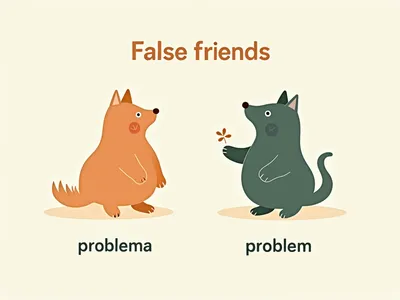
How do false friends differ from cognates in Italian
False friends and cognates in Italian differ mainly in their meanings despite similarities in appearance or sound:
-
False friends (falsi amici) are words that look or sound similar in Italian and another language (such as English) but have completely different meanings. For example, the Italian word “attualmente” means “currently” or “at present,” but it looks like the English word “actually,” which has a different meaning. Another example is “pretendere,” which means “to demand” in Italian, but resembles the English “to pretend,” which means something else entirely. These false friends can cause confusion because the words seem related but are not synonymous. 1 2 3
-
Cognates, on the other hand, are words that not only look or sound similar across languages but also share the same meaning due to a common linguistic origin. They are considered true friends in language learning since they help learners recognize vocabulary easily. For example, Italian “tavolo” and English “table,” or “animale” and “animal” are cognates. Cognates are usually easy to identify and remember. 4 5
In summary, the key difference is:
- False friends: Similar form but different meanings.
- Cognates: Similar form and same meanings.
This distinction is important for learners of Italian to avoid misunderstandings and help with vocabulary acquisition.
Why False Friends Are Particularly Challenging in Italian Learning
False friends create pitfalls because the learner’s brain naturally assumes that words that look or sound alike must share meanings. This mental shortcut can lead to embarrassing errors in conversation or writing. For example, misusing “eventualmente” (which means “possibly” or “potentially” in Italian) as “eventually” in English can distort the intended message—someone hearing the sentence might misunderstand the timeframe or certainty implied.
The confusion often emerges most strongly in speaking and listening, where the context might not immediately clarify the meaning. Since pronunciation of some false friends also closely resembles their English counterparts, the risk of misunderstanding in rapid conversation is high. For example, “libreria” means “bookstore,” which differs drastically from the English “library,” a place to borrow books.
How Cognates Boost Language Learning Efficiency
Cognates serve as linguistic anchors. Because they share meaning, spelling, and often pronunciation, recognizing cognates can dramatically speed up vocabulary acquisition. Italian shares thousands of cognates with English, especially words derived from Latin or Greek roots thanks to the historical influence of Latin on many European languages.
For example:
- “informazione” (information)
- “famiglia” (family)
- “problema” (problem)
This overlap allows learners to estimate meanings quickly, allowing them to dedicate more brainpower to mastering grammar or idiomatic expressions.
Pronunciation Differences and How They Affect False Friends and Cognates
Pronunciation can both aid and hinder recognition of false friends and cognates. Even when words look similar, their spoken forms in Italian and English can differ markedly, which may confuse learners during listening practice.
For instance, “camera” in Italian means “room,” but English speakers instinctively borrow the English pronunciation /ˈkæmərə/, while Italians say /ˈka.me.ra/. This difference makes it harder to link meaning based solely on sound.
Conversely, cognates often retain recognizable phonetic patterns, easing listening comprehension. Words like “telefono” (telephone) sound very similar to English and appear in many conversational contexts, making them easier to identify in natural speech.
Common False Friend Pairs Beyond the Basics
Expanding beyond the well-known examples, learners frequently stumble on subtle false friends such as:
- “Sensible” in Italian means “sensitive,” not “reasonable” or “practical” as in English.
- “Parenti” means “relatives” in Italian, not “parents.”
- “Fatto” means “fact” or “done,” but can be confused with English “fat” by pronunciation.
- “Educato” means “polite,” not “educated.”
These examples highlight how false friends often stem from shared roots but have “drifted” in meaning, a common phenomenon in languages through “semantic shift.”
Strategies to Minimize False-Friend Errors
-
Contextual learning: Always learn new vocabulary in context, not isolation. Real conversations or example sentences reveal which words make sense in given situations.
-
Active conversation practice: Engaging in speaking drills with attentive feedback can reinforce correct meaning and usage, reducing confusion from passive reading alone.
-
Flashcards with explanations: Include notes about false-friend traps in vocabulary cards to create mental alerts.
-
Comparison lists: Studying lists of known false friends side by side with their correct meanings increases conscious awareness during production or comprehension.
Historical and Linguistic Causes Behind Italian False Friends
False friends emerge because of the complex history of Italian and English influences. Italian evolved mainly from Latin, while English is a Germanic language enriched with Latin and French vocabulary after the Norman Conquest.
Some false friends represent “loan translations” or semantic loan shifts, where words borrowed from Latin roots retain different senses in each language. Over centuries, words like “pretendere” developed a specific Italian meaning (“to demand”), whereas the English “pretend,” although derived from the same root, evolved differently.
This divergence highlights the importance of studying each word’s usage and meaning independently rather than relying solely on surface similarities.
False Friends vs. False Cognates
In language learning, the term “false cognates” can arise as a subcategory of false friends. False cognates are words that appear to be cognates due to similar form but do not share a common etymological origin. For example, the Italian “burro” means “butter,” yet it is unrelated etymologically to the English “burro” (a small donkey borrowed from Spanish). Such words add another layer of complexity, as learners may assume a false relationship based on phonetic coincidence alone.
Understanding this nuance helps learners not only differentiate between false friends and true cognates, but also recognize when words that seem related historically are not.
Summary: Practical Focus for Conversation Readiness
The key takeaway in distinguishing false friends from cognates in Italian lies in their meaning alignment despite appearances. Learners benefit most by:
- Prioritizing vocabulary that aligns form and meaning (cognates) for rapid gains.
- Actively flagging false friends and learning their unique meanings through authentic use.
- Practicing listening and speaking to reinforce correct interpretations and avoid pitfalls common in false friends.
Accurate recognition of these categories reduces communication errors, improves comprehension, and builds confidence in real-world Italian use.