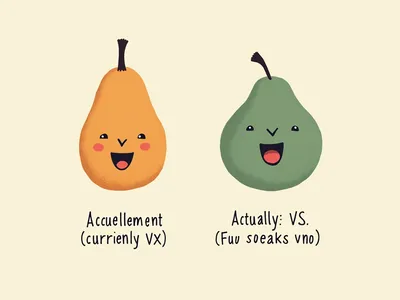
Are there any specific French words that are often confused with English words
There are indeed specific French words that are often confused with English words. These are typically known as “false friends” (faux amis), where words look or sound similar in both languages but have different meanings.
Common French-English false friends
A few of the most frequent traps are easy to recognise once they are grouped by meaning:
- Actuellement in French means “currently” or “at present,” not “actually.”
- Library in English vs. librairie in French, where the latter means “bookstore” not a library.
- Monnaie in French means “change” as in coins or small cash, not “money” in general.
- Sensible in French means “sensitive,” not “sensible” in English.
- Assisté in French often means “attended” or “was present at,” not the English “assisted.”
These words cause problems because the spelling or pronunciation suggests a familiar meaning, so the brain often guesses too quickly. In conversation, that guess can produce a sentence that is grammatically fine but semantically wrong.
Why false friends are so common between French and English
False friends are common because English and French share a large amount of vocabulary through Latin, Norman French, and centuries of borrowing in both directions. That shared history creates many pairs that look related at first glance, but the meanings have shifted over time.
A useful way to think about them is this: similar form does not guarantee identical use. Two words may be true cognates, partial cognates, or historical cousins that evolved separately. For learners, the danger is not only vocabulary recognition but also production, because a word that seems “obvious” is often the one most likely to be misused.
More French words that are often confused with English
Here are additional examples that regularly appear in beginner and intermediate French:
- Préservatif means “condom,” not “preservative.”
- Réunion means “meeting” or “gathering,” not necessarily a reunion in the emotional English sense.
- Location means “rental” or “letting,” not a place or location.
- Coin means “corner,” not a coin used as money.
- Déception means “disappointment,” not deception.
- Blesser means “to hurt” or “to injure,” not necessarily “to bless.”
- Rester means “to stay” or “to remain,” not “to rest.”
- Comprendre means “to understand,” not “to comprehend” in a formal or partial sense only; the overlap is real, but the everyday French verb is broader in use than many learners expect.
- Collège in French often means middle school, not a college or university.
- Assister à means “to attend” a meeting, class, or event, not simply “to assist.”
Some of these are especially tricky because they appear in real-life situations such as travel, housing, school, or social events. A learner who confuses location or réunion can easily misread a sign, email, or schedule.
A few especially misleading examples in speech
Some false friends are more dangerous in speaking than in reading because the sentence seems natural to the speaker:
- Je suis sensible au bruit means “I am sensitive to noise.”
- J’ai assisté à la réunion means “I attended the meeting.”
- Je cherche une librairie means “I’m looking for a bookstore.”
- Je n’ai pas assez de monnaie means “I don’t have enough change.”
These examples show why context matters as much as vocabulary. The surrounding words often reveal the intended meaning long before a dictionary does.
How to avoid false-friend mistakes
The most reliable habit is to learn false friends in short pairs or phrases, not as isolated words. A pair like actuellement = currently is easier to retain than a single memorised definition.
A practical approach is:
- Notice the trap word when reading or listening.
- Check the surrounding context for clues: money, school, travel, work, and emotions each have their own vocabulary.
- Learn the whole phrase, especially prepositions such as à in assister à.
- Repeat the word in a full sentence, because sentence-level memory is stronger than dictionary memory.
- Compare it with a native-like equivalent, not just with a direct translation.
Conversation practice is especially useful here, because false friends tend to appear in spontaneous speech where there is no time to stop and analyse each word. Active use forces the correct meaning to become automatic.
Fast memory tricks for common false friends
A few small associations can make these words easier to keep apart:
- Actuellement contains “act”, which can help recall what is happening now.
- Librairie contains “book” territory, not library shelves; in French, the library is bibliothèque.
- Monnaie connects to small change, while argent is the general word for money.
- Sensible can be remembered as emotionally sensitive, not “reasonable.”
- Rester often pairs with the idea of staying in one place.
These memory aids are not perfect etymologies, but they work because they attach the French word to a stable image instead of a misleading English lookalike.
FAQ
Are all similar-looking French and English words false friends?
No. Many are genuine cognates with similar meanings, such as important, nation, or possible. The challenge is that a minority of lookalikes have shifted meaning enough to cause mistakes.
Is “faux amis” the standard term?
Yes. Faux amis is the standard French expression for false friends.
Which false friends should be learned first?
The most useful first set is the one that appears in daily life: actuellement, librairie, sensible, assister à, rester, réunion, location, préservatif, and déception. These words come up in travel, study, housing, health, and everyday conversation, so they produce the fastest payoff.
Why do false friends matter so much in real conversation?
Because a single wrong word can change the meaning of an entire sentence. In French, that can mean confusing staying with resting, attending with assisting, or bookstore with library—small differences that have large practical consequences.
References
-
Dissociated mechanisms for phonetic and lexical learning in a second language
-
The Phenomenon of Loan Words That Often Used in Social Media
-
Visual words in notes English language SDN Layungsari 2 Bogor City
-
Cross-cultural Study of the Concepts of “Shame” and “Guilt” in English and Romanian
-
Linguistic Aspects of Translation Between French and English
-
ANGLICISMS IN THE FRENCH LANGUAGE: LINGUISTIC AND SOCIAL ASPECTS
-
Au-delà des genres: décalages stylistiques entre l’anglais et le français
-
Teenagers’ Attitudes Towards Franglais in France and Francophone Switzerland
-
Exploring the Influence of French on the Pronunciation of the Letter h in English Words
-
Indeterminacy in L1 French grammars: the case of gender and number agreement