How can I avoid using false friends in Spanish
To avoid false friends in Spanish, the most effective habit is to learn the misleading pairs in context, not as isolated vocabulary. A short list of high-frequency traps, plus regular reading and speaking practice, prevents many of the mistakes that even intermediate learners make.
What false friends are
False friends are words that look or sound similar in two languages but mean something different. In Spanish, they are especially common for English speakers because many Spanish words come from Latin and resemble English forms without sharing the same meaning.
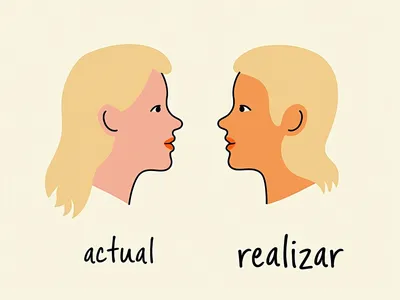
A classic example is actual, which means current or present-day in Spanish, not actual or real. Another common trap is realizar, which means to carry out, to do, or to accomplish, not to realize in the sense of becoming aware of something. The correct Spanish for “I realized that…” is usually me di cuenta de que…
Learn the most common false friends first
The quickest way to reduce errors is to memorize a small core list of high-risk words that appear often in conversation, news, and writing.
Common examples include:
- actual = current, present-day
- realizar = to carry out, to accomplish
- asistir = to attend
- sensible = sensitive
- éxito = success
- carpeta = folder
- embarazada = pregnant
- constipado/a = having a cold
- librería = bookstore
- sopa = soup
Some of these are especially dangerous because they produce fluent-sounding but wrong sentences. For example, Estoy embarazada means “I’m pregnant,” which can surprise learners who were aiming for a different meaning. Asistir a una reunión means “to attend a meeting,” while ayudar means “to help.”
Pay attention to the full phrase, not just the single word
False friends are easier to spot when the whole sentence is considered. Spanish often reveals meaning through the surrounding verb, article, or preposition.
For example:
- realizar un proyecto = to carry out a project
- darse cuenta de un error = to realize a mistake
- asistir a clase = to attend class
- tener sensibilidad = to have sensitivity
This matters because the same-looking word can behave differently depending on structure. In Spanish, asistir does not normally mean “to assist someone” in the English sense; that meaning is usually ayudar. In the same way, carpeta may look related to “carpet,” but in ordinary Spanish it usually refers to a folder, binder, or file holder.
Build a contrast list in two columns
A practical method is to keep a two-column list: one column for the misleading Spanish word and one for the correct English meaning. Adding a sample sentence makes the memory stronger.
Examples:
| Spanish | Correct meaning | Example |
|---|---|---|
| actual | current | la situación actual |
| realizar | carry out | realizar un estudio |
| asistir | attend | asistir al concierto |
| sensible | sensitive | una persona sensible |
| éxito | success | tuvo mucho éxito |
This format works because it links the word to a real usage pattern instead of to a guessed translation. Learners who study vocabulary in phrases generally recall it more reliably than learners who memorize single-word pairs only.
Use context clues before translating automatically
Many false-friend errors come from translating too quickly. A useful habit is to pause and ask what the word could mean in Spanish before mapping it to the nearest English lookalike.
Context clues often solve the problem:
- If librería appears near comprar or novelas, it probably means bookstore, not library.
- If sensible appears near piel, persona, or tema, it usually means sensitive.
- If realizar appears near plan, obra, or tarea, it often means to carry out or complete.
Spanish and English share many similar-looking words, but the safest interpretation is always the one that fits the sentence. This is especially important in conversation, where fast comprehension depends on recognizing the intended meaning instantly.
Practice with speaking and writing, not just recognition
Passive recognition is not enough. A word that looks familiar on a page can still be misused when producing Spanish from memory.
Effective practice includes:
- writing short example sentences
- reading them aloud
- substituting one false friend with the correct Spanish word
- repeating the correction in another sentence
For example:
-
Wrong: Necesito asistir a mi amigo
-
Right: Necesito ayudar a mi amigo
-
Wrong: Realicé that I was late
-
Right: Me di cuenta de que llegaba tarde
Producing the sentence forces the brain to retrieve the meaning actively, which is much more effective than passive review. Regular conversation practice accelerates this process because it makes the difference between similar words matter in real time.
Use mnemonics for the trickiest pairs
Mnemonics help when two words are especially easy to confuse. A good mnemonic is short, concrete, and tied to the correct Spanish meaning.
Examples:
- actual → “actual = current news article”
- realizar → “realize = become aware; realizar = do something real in the world”
- asistir → “assist” does not match; asistir means attending a place or event
- sensible → “sensitive, sense-able”
- éxito → “success is a victory, not an exit”
The goal is not to invent a perfect story for every word, but to create a mental cue that stops the automatic wrong translation.
Expect mistakes and correct them quickly
False friends are normal even for advanced learners. The important thing is to notice the pattern early and correct it often enough that the wrong association weakens.
When a mistake happens, the correction should be immediate and specific:
- identify the exact word
- write the correct meaning
- use it in one new sentence
- review it again later the same day
This kind of correction is more effective than simply knowing that “I made a mistake.” The brain remembers precise contrasts better than vague criticism.
Keep a small personal cheat sheet
A compact cheat sheet is useful because false friends recur. A list of 15 to 30 recurring traps covers a large share of the most common errors for everyday Spanish.
A good personal list includes words encountered in reading, travel, work, and conversation. For example, someone studying travel Spanish may want to prioritize embarazada, asistir, and éxito, while someone reading news articles may focus on actual, realizar, and sensible.
The best cheat sheet is the one that gets used often. Keeping it near reading materials or reviewing it before speaking practice makes the correction automatic over time.
Common false-friend traps to watch for
Some pairs deserve special attention because they cause frequent misunderstandings:
- éxito means success, not exit
- librería means bookstore, not library
- sopa means soup, not soap
- ropa means clothes, not rope
- asistir means to attend, not to assist
- realizar means to carry out, not to realize
- sensible means sensitive, not sensible
- actual means current, not actual
- carpeta means folder, not carpet
A few of these are humorous in isolation, but in real conversation they can cause confusion or embarrassment. That is why the safest approach is to treat them as vocabulary items with fixed meanings, not as guessable cognates.
The most reliable habit
The most reliable way to avoid false friends in Spanish is simple: learn the dangerous pairs, see them in sentences, and use them repeatedly in speaking and writing. Translation alone is not enough, because false friends are a meaning problem, not just a spelling problem.
With enough exposure, the correct Spanish meaning becomes automatic. The word stops looking familiar in an English way and starts functioning as Spanish vocabulary, which is the point where confusion begins to drop sharply.
References
-
Spanish English False Cognates / False Friends(8 most … - YouTube
-
“False Friends” to watch out for | Intermediate and Advanced Spanish
-
7 False Cognates in Spanish & English [in Spanish] how … - YouTube