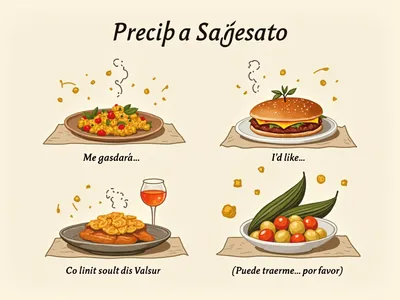
What are some common phrases for ordering food in a Spanish restaurant
Here are some common Spanish phrases for ordering food in a restaurant:
Getting Ready to Order
- ¿Están listos? (Are you ready?)
- ¿Están listos para ordenar? (Are you ready to order?)
- ¿Les puedo tomar su orden? (May I take your order?)
- Sí, estamos listos. (Yes, we are ready.)
- Todavía no estamos listos. (We are not ready yet.)
- Necesitamos unos minutos más. (We need a few more minutes.)
In many Spanish-speaking restaurants, the server may use ustedes-style forms such as están and les, even in countries where people commonly say ustedes in everyday speech and in places where vosotros is also familiar. The safest reply is usually short and direct: Sí, estamos listos or Necesitamos unos minutos más.
Placing Your Order
- Va a ser… (It’s going to be…) — e.g., Va a ser una hamburguesa para mí. (It’s going to be a burger for me.)
- ¿Me puede traer…, por favor? (Can you bring me…, please?)
- ¿Me puede dar…, por favor? (Can you give me…, please?)
- Quiero…, por favor. (I want…, please.)
- Me gustaría… / Quisiera… (I would like…)
Me gustaría and quisiera are usually better than quiero in a restaurant because they sound softer and more polite. Va a ser… is very common in casual ordering, especially when naming items one by one. For example: Va a ser la sopa y el pollo.
A natural structure for ordering is Quisiera + item or Me gustaría + item:
- Quisiera una ensalada.
- Me gustaría el pescado.
- Quisiera agua sin gas, por favor.
If a place is informal, para mí is also useful:
- Para mí, la pasta.
- Para mí, un café.
Asking About the Menu or Recommendations
- ¿Puedo ver el menú de postres? (Can I see the dessert menu?)
- ¿Qué me recomienda? (What do you recommend?)
- ¿Cuál es el plato del día? (What is the dish of the day?)
- ¿Hay alguna especialidad de la casa? (Is there a house specialty?)
These questions are especially useful because restaurant vocabulary often changes by country and region. Plato del día is the daily special, while especialidad de la casa means the restaurant’s signature dish or a house specialty. If a menu is confusing, a very practical phrase is:
- ¿Qué lleva este plato? (What does this dish contain?)
- ¿Es picante? (Is it spicy?)
- ¿Tiene carne? (Does it have meat?)
- ¿Es vegetariano/a? (Is it vegetarian?)
Common Add-Ons and Modifications
Real restaurant conversation often includes small changes to the order. These phrases are extremely useful because they help avoid misunderstandings.
- Sin cebolla, por favor. (Without onion, please.)
- Sin queso. (Without cheese.)
- Con hielo. (With ice.)
- Sin hielo. (Without ice.)
- Para llevar. (To go.)
- Para aquí. (For here / to eat here.)
- Bien cocido. (Well cooked.)
- Poco hecho. (Rare / undercooked.)
- ¿Puede hacerlo sin…? (Can you make it without…?)
A simple pattern that works well is sin + ingredient or con + ingredient:
- Una hamburguesa sin tomate.
- Un café con leche.
- Unos tacos con salsa picante.
In Spanish, para llevar and para aquí are enough in many places, especially when the context is obvious. Para llevar is one of the most common phrases in casual food service settings.
During the Meal
- ¿Todo bien? (Is everything alright?)
- ¿Necesitan algo? (Do you need anything?)
- Te encargo otra bebida, por favor. (I’d like another drink, please.)
- ¿Me puedes traer un vaso de agua, por favor? (Can I have a glass of water, please?)
During a meal, requests are often made with ¿Me puede…? or ¿Me trae…?, both of which sound natural and polite in service situations. In some regions, te encargo is very common in restaurants and means roughly “I’ll have” or “please bring me,” even though the literal translation sounds different in English.
Useful follow-up phrases include:
- La comida está muy buena. (The food is very good.)
- Está delicioso/a. (It’s delicious.)
- Falta un tenedor, por favor. (There’s a fork missing, please.)
- ¿Nos puede traer más pan? (Can you bring us more bread?)
Paying and Finishing Up
- La cuenta, por favor. (The bill, please.)
- ¿La propina está incluida? (Is the tip included?)
- Nos gustaría pagar juntos / por separado. (We’d like to pay together / separately.)
At the end of the meal, la cuenta is the standard phrase for “the bill.” In some places, the server may not bring it until it is requested, so La cuenta, por favor is often the most useful closing phrase. If splitting the bill, por separado is the clearest expression.
A few extra useful phrases are:
- ¿Aceptan tarjeta? (Do you accept card?)
- ¿Me da el recibo, por favor? (Can you give me the receipt, please?)
- Gracias, muy amable. (Thank you, very kind.)
Using polite words like “por favor” (please) and “gracias” (thank you) while speaking these phrases is important and shows good manners. Also, things like “¿Me puede…?” sound polite and respectful.
A few pronunciation habits make these phrases easier to use smoothly. In fast speech, me puede often sounds lighter than it looks on the page, and gracias is usually pronounced with a soft s sound at the end in most Latin American varieties and much of Spain. Clear stress on the key noun usually matters more than perfect grammar when ordering food.
Common mistakes are usually simple:
- Saying quiero in a way that sounds abrupt when quisiera would be softer.
- Forgetting por favor in requests.
- Mixing up para llevar and para aquí.
- Using a direct translation from English such as “give me” without the polite frame ¿Me puede dar…?
A practical ordering sequence in Spanish often looks like this:
- Greet the server.
- Ask for a menu or a recommendation.
- Place the order politely.
- Add any changes, such as sin cebolla or para llevar.
- Ask for the bill: La cuenta, por favor.