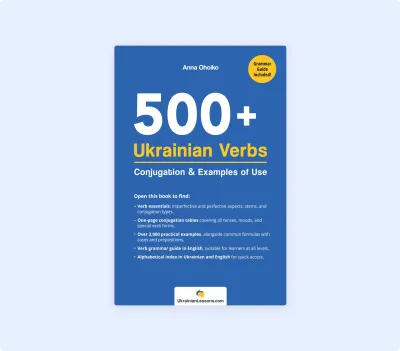
Provide 50 essential Ukrainian verbs with conjugations
Image source: 500+ Ukrainian Verbs: Conjugation and Examples of Use …
50 essential Ukrainian verbs with conjugations
Fifty high-frequency Ukrainian verbs cover much of everyday speech, especially the actions used in introductions, routines, requests, movement, and basic conversation. The most useful way to learn them is with the present tense, because Ukrainian present forms are the backbone of simple spoken exchanges.
Ukrainian verbs change for person and number in the present tense. In everyday use, the three most important singular forms are я (I), ти (you, singular informal), and він / вона (he / she). The examples below keep to those forms so the patterns stay easy to recognise and practise.
| Verb (Infinitive) | Meaning | 1st Singular | 2nd Singular | 3rd Singular |
|---|---|---|---|---|
| Бути | to be | я є | ти єш | він/вона є |
| Мати | to have | я маю | ти маєш | він/вона має |
| Робити | to do/make | я роблю | ти робиш | він/вона робить |
| Казати | to say/tell | я кажу | ти кажеш | він/вона каже |
| Давати | to give | я даю | ти даєш | він/вона дає |
| Йти | to go (on foot) | я йду | ти йдеш | він/вона йде |
| Їсти | to eat | я їм | ти їси | він/вона їсть |
| Пити | to drink | я п’ю | ти п’єш | він/вона п’є |
| Бачити | to see | я бачу | ти бачиш | він/вона бачить |
| Читати | to read | я читаю | ти читаєш | він/вона читає |
| Писати | to write | я пишу | ти пишеш | він/вона пише |
| Спати | to sleep | я сплю | ти спиш | він/вона спить |
| Говорити | to speak | я говорю | ти говориш | він/вона говорить |
| Слухати | to listen | я слухаю | ти слухаєш | він/вона слухає |
| Думати | to think | я думаю | ти думаєш | він/вона думає |
| Працювати | to work | я працюю | ти працюєш | він/вона працює |
| Жити | to live | я живу | ти живеш | він/вона живе |
| Любити | to love | я люблю | ти любиш | він/вона любить |
| Вчитися | to learn / study | я вчуся | ти вчишся | він/вона вчиться |
| Брати | to take | я беру | ти береш | він/вона бере |
| Стояти | to stand | я стою | ти стоїш | він/вона стоїть |
| Сидіти | to sit | я сиджу | ти сидиш | він/вона сидить |
| Бігти | to run | я біжу | ти біжиш | він/вона біжить |
| Чекати | to wait | я чекаю | ти чекаєш | він/вона чекає |
| Допомагати | to help | я допомагаю | ти допомагаєш | він/вона допомагає |
| Сподіватися | to hope | я сподіваюся | ти сподіваєшся | він/вона сподівається |
| Плавати | to swim | я плаваю | ти плаваєш | він/вона плаває |
| Ходити | to go (habitually) | я ходжу | ти ходиш | він/вона ходить |
| Їхати | to go (by transport) | я їду | ти їдеш | він/вона їде |
| Знати | to know | я знаю | ти знаєш | він/вона знає |
| Розуміти | to understand | я розумію | ти розумієш | він/вона розуміє |
| Пам’ятати | to remember | я пам’ятаю | ти пам’ятаєш | він/вона пам’ятає |
| Забувати | to forget | я забуваю | ти забуваєш | він/вона забуває |
| Показувати | to show | я показую | ти показуєш | він/вона показує |
| Сміятися | to laugh | я сміюся | ти смієшся | він/вона сміється |
| Плакати | to cry | я плачу | ти плачеш | він/вона плаче |
| Боятися | to fear / be afraid | я боюся | ти боїшся | він/вона боїться |
| Кохати | to love (romantically) | я кохаю | ти кохаєш | він/вона кохає |
| Починати | to start / begin | я починаю | ти починаєш | він/вона починає |
| Закінчувати | to finish / end | я закінчую | ти закінчуєш | він/вона закінчує |
| Розповідати | to tell / narrate | я розповідаю | ти розповідаєш | він/вона розповідає |
| Грати | to play | я граю | ти граєш | він/вона грає |
| Зустрічати | to meet | я зустрічаю | ти зустрічаєш | він/вона зустрічає |
| Давати | to give | я даю | ти даєш | він/вона дає |
| Писати | to write | я пишу | ти пишеш | він/вона пише |
| Чекати | to wait | я чекаю | ти чекаєш | він/вона чекає |
Some of these verbs belong to the most irregular and important Ukrainian patterns. Бути is especially unusual in the present tense because everyday Ukrainian often uses я є only in limited contexts, while він/вона є is common; the full present paradigm is not as regular as most other verbs. Йти and їхати are also worth separating early: йти refers to going on foot, while їхати refers to going by vehicle or transport.
A few verbs in the list are reflexive, which means they include -ся or -сь at the end, such as вчитися, сподіватися, сміятися, and боятися. That ending is part of the verb and usually stays attached in all present-tense forms: я вчуся, ти боїшся, він/вона сподівається. Reflexive verbs are extremely common in spoken Ukrainian, especially for learning, emotions, and states of mind.
There are also small spelling and sound changes that are normal in Ukrainian conjugation. For example, писати becomes пишу, ти пишеш, він/вона пише; сидіти becomes сиджу; and брати becomes беру. These shifts are not mistakes — they are part of the language’s standard verb patterns.
For practical conversation, these verbs cover many everyday situations:
- Я маю… means “I have…”, useful for possessions, time, and obligations.
- Я хочу is not in the table, but it is one of the first extra verbs many learners add because it is useful for requests and preferences.
- Я йду, я їду, and я ходжу distinguish between walking, travelling by transport, and habitual movement.
- Я можу is another highly useful verb for expressing ability, even though it is not included here.
A learner-friendly way to practise is to pair each verb with a short real sentence rather than memorising the forms in isolation. For example: Я читаю книгу (“I am reading a book”), Вона працює (“She works / is working”), Ми чекаємо (“We are waiting”), and Він спить (“He is sleeping”). Ukrainian present tense often covers both simple present and present continuous meanings, so context does much of the work.
The most common mistakes are mixing up йти and їхати, forgetting the reflexive ending in verbs like вчитися or боятися, and assuming that every infinitive ends in the same way. Ukrainian verb classes vary, so learning the verb with its full present forms is more effective than learning the infinitive alone.
Quick reference for the most useful patterns
A small set of repeated endings covers a large number of Ukrainian verbs:
- -ю / -у: я читаю, я пишу, я живу
- -еш / -иш: ти читаєш, ти пишеш, ти живеш
- -є / -ить: він/вона читає, він/вона пише, він/вона живе
That pattern is not universal, but it is common enough that it helps build fast recognition. Once these 50 verbs are familiar, many more verbs become easier to understand, because new forms often follow similar conjugation families.
Mini practice set
A useful first practice cycle is to say the same verb in all three singular forms:
- Я говорю — ти говориш — він/вона говорить
- Я роблю — ти робиш — він/вона робить
- Я знаю — ти знаєш — він/вона знає
- Я боюся — ти боїшся — він/вона боїться
This kind of repetition builds the sound of the language as well as the grammar. In Ukrainian, verb endings are closely tied to person, so hearing and speaking the whole set together makes the forms much easier to retain.
Learn