How can I avoid using false friends in German conversations
Avoiding false friends in German conversations starts with one simple habit: never trust a word just because it looks familiar. German and English share many similar-looking words, but some of the most tempting matches mean something completely different, so checking context before speaking is the safest way to stay accurate.
Why false friends cause so much trouble
False friends are words that look or sound similar in two languages but have different meanings. In German conversation, they are especially risky because many of them are short, common words that learners feel confident about too quickly.
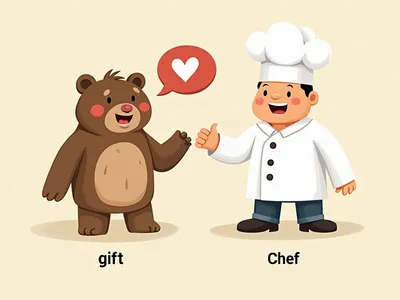
A wrong guess can sound more serious than a small grammar mistake. Saying Gift when meaning “gift” produces “poison,” and using Chef as if it meant “cook” produces “boss.” These are the kinds of errors that can derail a conversation because the listener understands a different message immediately.
Learn the highest-risk false friends first
The fastest way to reduce mistakes is to memorize the most common false friends before they become habits. A few of the most useful ones to learn early are:
- Gift = poison, not a present
- Chef = boss, not a cook
- sympathisch = likable, not sympathetic in the English sense
- Mist = crap or dung, not light fog
- eventuell = possibly or maybe, not eventually
These words appear often enough in everyday speech that they are worth learning as fixed warnings rather than as isolated vocabulary items.
Learn words in full sentences, not as single translations
A false friend is much easier to avoid when it is tied to a real sentence. For example, Ich habe sensible Haut means “I have sensitive skin,” while “That was a very sensible decision” uses sensible in English to mean rational or practical. The spelling looks similar, but the sentence context tells the real meaning.
This is why vocabulary learned only as one-word translations is fragile. German words are safest when they are stored with article, collocation, and example sentence, such as der Chef, giftig, or sympathisch zu jemandem. A word learned with context is less likely to be misread in conversation.
Watch for meaning shifts that seem small but matter
Some false friends do not look dramatic, but their meaning changes the tone of a sentence.
- eventuell in German means “maybe,” so eventuell komme ich später means “maybe I’ll come later.”
- sensibel in German usually means “sensitive” in the emotional or physical sense, not “sensible.”
- aktuell means “current” or “up to date,” not “actual.”
- bekommen means “to receive,” not “to become.”
These are especially useful to learn because they show up in everyday small talk, schedules, and practical conversations.
Use the surrounding sentence as a reality check
When a familiar-looking German word appears, pause and ask what would make sense in that sentence. If Chef appears in a workplace context, “boss” fits naturally. If Limonade appears on a German menu, it usually refers to a carbonated soft drink, not the still lemon drink many English speakers imagine.
This habit is more reliable than word-to-word translation. German, like any language, assigns meaning through usage patterns, and a word that looks familiar can still behave differently in real speech.
Build a personal false-friend list
The most effective memory aid is a short list of personal troublemakers. A learner who repeatedly confuses eventuell, aktuell, and bekommen will benefit more from a private review list than from a broad vocabulary notebook.
A useful list often includes:
- the German word
- the real meaning
- the mistaken English meaning
- one example sentence
For example:
- aktuell = current / up to date
- mistaken meaning: actual
- Die aktuellen Preise sind gestiegen.
This format makes the contrast harder to forget because the confusion is visible on the page.
Use mnemonics that stress the correct meaning
Mnemonics work well for false friends because the goal is not just memorization, but instant recall during speech. A strong association can prevent a word from being guessed in the wrong direction.
For Gift, the easiest memory cue is danger: the word looks harmless, but the meaning is toxic. For Chef, the strongest association is authority, not food. For Mist, linking it to something unpleasant helps prevent the English meaning of fog from taking over.
The best mnemonics are short, vivid, and slightly exaggerated. A dramatic image is easier to recall than a neat definition.
Ask for clarification before a mistake becomes fixed
In conversation, a quick clarification is often better than forcing a guess. Phrases such as Meinst du X oder Y? (“Do you mean X or Y?”) or Kannst du das anders sagen? (“Can you say that differently?”) keep the conversation moving while reducing the chance of misunderstanding.
This is especially useful with words that seem transparent but are not. Native speakers are used to clarifying meaning, and a short follow-up question is far less disruptive than using the wrong noun in a sensitive situation.
Practice speaking with immediate correction
False friends disappear faster when speaking practice includes correction at the moment of use. Reading a list is helpful, but active conversation makes the difference between recognition and automatic control. Speaking practice forces the learner to choose meanings in real time, which is exactly where false friends usually appear.
Pay attention to regional and usage differences
Some words are not true false friends in every context, but their everyday meaning can still vary enough to cause trouble. German Limonade is a good example: in German-speaking countries, it often refers to a fizzy soft drink, while English “lemonade” is usually a non-carbonated lemon drink with sugar.
This matters because a word may be “correct” in a dictionary sense and still be unexpected in actual conversation. Menu language, everyday shopping, and informal speech are all places where usage can differ from the assumption a learner brings from English.
A practical routine for avoiding false friends
A simple habit loop works better than trying to remember everything at once:
- Learn the most common false friends first.
- Store each one in a sentence, not as a single translation.
- Mark the dangerous ones in a review list.
- Confirm meaning from context before speaking.
- Ask for clarification when a word feels uncertain.
- Reuse the corrected form several times in conversation.
Used consistently, this routine turns false friends from surprise traps into familiar check points.
Quick checklist for German conversations
Before using a familiar-looking German word, check three things:
- Does it mean the same thing in German as in English?
- Does the surrounding sentence support that meaning?
- Is there a more precise word that avoids ambiguity?
If the answer to any of these questions is uncertain, it is safer to rephrase.
Common false-friend examples to keep in mind
Some of the most useful examples for everyday conversation are:
- Gift = poison
- Chef = boss
- sympathisch = likable
- Mist = crap or dung
- eventuell = maybe
- aktuell = current
- bekommen = receive
- Limonade = carbonated soft drink
Learning these early prevents many of the mistakes that happen when English-looking words are assumed to be transparent.
The main principle
False friends are easiest to avoid when meaning is learned as usage, not as a guess from spelling. The most reliable approach is to memorize the high-frequency traps, confirm them in context, and practice them in real conversation until the correct meaning becomes automatic.
References
-
Avoid these embarrassing False Friends! | German Vocabulary Lesson
-
Falsche Freunde Deutsch Englisch Spanisch | False friends - YouTube
-
False Friends/Falsche Freunde | Learn German Lesson - YouTube