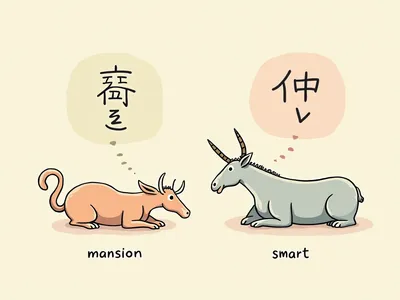
False friends when learning Japanese
False friends in Japanese are words that look or sound familiar but mean something different from the English word they resemble. The biggest traps are often gairaigo, Japanese loanwords written in katakana, because their meanings can shift after entering Japanese usage.
Why false friends happen in Japanese
Japanese borrowed thousands of foreign words, especially from English, and many of them developed Japanese-specific meanings. That means the spelling or pronunciation may look obvious, but the actual usage can be narrower, broader, or simply different.
Common false friends in Japanese
1. Mansion (マンション)
In Japanese, マンション means an apartment building or condominium, not a large, luxurious house. A phrase like 新しいマンション usually means “a new apartment building” or “a new condo,” not a mansion in the English sense.
- English assumption: a big, expensive house
- Japanese meaning: apartment, condo, multi-unit residence
This is one of the most famous false friends because it is used in everyday speech, real-estate listings, and casual conversation.
2. Consent (コンセント)
In Japanese, コンセント means an electrical outlet or socket. It does not mean permission, agreement, or consent.
- English assumption: approval, agreement
- Japanese meaning: wall socket, plug outlet
A sentence such as コンセントはどこですか? means “Where is the outlet?” This word is so common in daily life that learners often encounter it before realizing it has nothing to do with giving permission.
3. Viking (バイキング)
In Japanese, バイキング usually refers to a buffet-style meal. It does not mean a Norse raider, sailor, or historical Viking.
- English assumption: people from Scandinavia in the Viking Age
- Japanese meaning: buffet, all-you-can-eat style dining
A restaurant sign like バイキング形式 means “buffet style.” The association comes from a Japanese branding history rather than from the English word’s original meaning.
4. Smart (スマート)
In Japanese, スマート often means slim, sleek, or stylish. It is not the default word for “intelligent.”
- English assumption: clever, brainy
- Japanese meaning: slim, elegant, neat, streamlined
A phrase such as スマートな体型 means “a slim build,” and スマートな解決 suggests an elegant or neat solution. For “smart” in the sense of intelligence, Japanese usually uses words like 頭がいい or 賢い depending on the situation.
Other false friends worth knowing
Camera (カメラ)
This one is mostly safe, but カメラ can sometimes appear in contexts that are broader than a still camera, including video equipment or camera-related systems. The meaning is close enough to English that it is usually not a major trap, but context still matters.
Service (サービス)
サービス does mean service, but in Japanese it often also means a bonus, free extra, or special deal. In shops and restaurants, サービスします can mean “I’ll include something extra” or “I’ll give you a discount/freebie,” not necessarily “I’ll provide customer service.”
My pace (マイペース)
マイペース does not mean “at my own pace” in a purely literal sense. It often describes someone who proceeds in their own way, calmly or stubbornly, regardless of other people’s speed or expectations.
Salaryman (サラリーマン)
This word resembles “salary man,” but in Japanese it specifically means a white-collar office worker, usually male and employed full-time. It is a social category as much as a job description.
How to avoid false-friend mistakes
- Learn the katakana meaning, not the English-looking meaning. If a loanword appears in Japanese, check how Japanese speakers actually use it.
- Read example sentences. A single example often reveals the real meaning faster than a dictionary definition alone.
- Watch for fixed expressions. Words like コンセント and マンション are best remembered as part of common phrases.
- Pay attention to registers. Some loanwords sound casual, businesslike, trendy, or old-fashioned depending on the context.
- Check pronunciation and spelling together. Japanese katakana often preserves the sound of the source word, but the meaning may drift.
Why false friends matter in conversation
False friends can create misunderstandings that are more embarrassing than serious. Asking コンセントはありますか? at a hotel makes perfect sense in Japanese, but translating it word-for-word into English leads to nonsense. Likewise, saying スマートな人 may sound like “a smart person” to an English speaker, but in Japanese it usually suggests someone is stylish or slender rather than highly intelligent.
That mismatch is especially important in spontaneous conversation, where there is no time to stop and reinterpret a familiar-looking word. Learning the Japanese meaning as a whole expression makes everyday speech much more reliable.
A simple rule for learners
If a Japanese loanword looks familiar, treat it as new vocabulary first and borrowed vocabulary second. The resemblance to English is useful for memorization, but it is not a guarantee of meaning.
Quick reference
- マンション = apartment, condominium
- コンセント = electrical outlet
- バイキング = buffet
- スマート = slim, stylish, sleek
- サービス = service, bonus, free extra
- マイペース = doing things in one’s own way
- サラリーマン = office worker, salaried worker