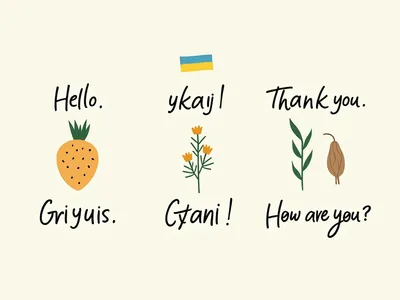
What are the most common phrases used in everyday Ukrainian
What are the most common phrases used in everyday Ukrainian
The most common everyday Ukrainian phrases are short, high-frequency expressions for greeting people, being polite, asking simple questions, and handling basic situations like shopping or asking for help. The most useful ones are Привіт (Pryvit), Доброго дня (Dobroho dnia), Дякую (Dyakuyu), Будь ласка (Bud’ laska), Вибачте (Vybachte), and Я не розумію (Ya ne rozumiyu).
These phrases do most of the work in ordinary conversation because they appear in nearly every interaction: meeting someone, thanking them, apologizing, buying something, or asking for clarification. In spoken Ukrainian, a small set of phrases can carry a surprising amount of meaning when used with the right tone and pronunciation.
The most useful everyday Ukrainian phrases
-
Привіт (Pryvit) — Hello / Hi
A friendly, informal greeting used with friends, peers, and people of similar age. -
Доброго дня (Dobroho dnia) — Good day
A polite, neutral greeting suitable in shops, at work, or with strangers. -
Як справи? (Yak spravy?) — How are you?
A common everyday question in informal conversation. -
Дякую (Dyakuyu) — Thank you
One of the most important words in Ukrainian daily life. -
Будь ласка (Bud’ laska) — Please / You’re welcome
Used both to make a request politely and to respond after thanks. -
Вибачте (Vybachte) — Excuse me / Sorry
A polite form used to apologize or get someone’s attention. -
До побачення (Do pobachennya) — Goodbye
A standard, polite farewell. -
Скільки це коштує? (Skil’ky tse koshtuye?) — How much does it cost?
Essential for shopping, markets, taxis, and everyday errands. -
Я не розумію (Ya ne rozumiyu) — I don’t understand
Useful whenever speech is too fast, unclear, or unfamiliar. -
Допоможіть, будь ласка (Dopomozhit’, bud’ laska) — Help, please
A direct request for assistance in an urgent or difficult situation.
How these phrases are used in real conversation
Ukrainian has both informal and polite patterns, and choosing the right one matters. Привіт sounds casual, while Доброго дня sounds more formal and respectful. The same difference appears in farewells: До побачення is a safe default in formal or unfamiliar settings, while more casual goodbyes may be used with friends.
Politeness also depends on how requests are phrased. Будь ласка is one of the most versatile expressions in Ukrainian because it can soften a request or act as a response to thanks. In everyday speech, it often appears in short exchanges such as Дякую — Будь ласка.
Common phrase groups to learn first
A practical way to memorize Ukrainian is by situation rather than by isolated words. The most common phrase groups are:
- Greetings: Привіт, Доброго дня
- Politeness: Дякую, Будь ласка, Вибачте
- Basic questions: Як справи?, Скільки це коштує?
- Help and clarification: Я не розумію, Допоможіть, будь ласка
- Farewells: До побачення
These groups cover most beginner interactions and are especially useful in spoken practice, where quick recall matters more than perfect grammar.
Pronunciation notes that matter
Ukrainian spelling is usually quite consistent, so learning the written form and the spoken form together is efficient. A few phrases deserve extra attention:
- Доброго дня is often pronounced smoothly in connected speech.
- Дякую has a soft, flowing sound and is one of the first words worth practicing aloud.
- Будь ласка includes sounds that can feel unfamiliar at first, especially the soft ль sound.
- Я не розумію is useful not only because of its meaning, but because it gives practice with very common pronunciation patterns.
Short, repeated speaking practice helps these phrases become automatic more quickly than silent review alone.
Useful variations
Everyday Ukrainian often has more than one natural way to say the same thing.
- Привіт is informal; Доброго дня is more neutral and polite.
- Вибачте is a polite “excuse me” or “sorry”; in close, casual conversation, a shorter apology may sound more natural.
- Будь ласка can mean both “please” and “you’re welcome,” depending on context.
- Я не розумію is a clear, standard way to say “I don’t understand,” while some speakers may use simpler or more conversational alternatives.
Learning one standard version first is usually the best approach, because it is broadly understood and safe in most situations.
A simple starter set for daily use
For a learner beginning Ukrainian, ten phrases cover a large share of basic interaction:
- Привіт
- Доброго дня
- Як справи?
- Дякую
- Будь ласка
- Вибачте
- До побачення
- Скільки це коштує?
- Я не розумію
- Допоможіть, будь ласка
That set is small enough to memorize quickly, but broad enough to handle greetings, shopping, politeness, and basic problems.
Why these phrases matter
Everyday phrases are the fastest route to usable Ukrainian because they appear constantly and can be recycled in many situations. A learner who can greet someone, thank them, ask for the price, and say “I don’t understand” already has the tools for dozens of real-world interactions.
In conversation practice, short phrases like these are especially valuable because they train quick recall, pronunciation, and response timing at the same time.
References
-
Word-forming models of neologisms of the Russian-Ukrainian war period
-
New Bulgarian, Polish, and Ukrainian phraseology and language corpora
-
MAIN TYPES OF AMERICAN SLANG AND ITS TRANSLATION INTO UKRAINIAN
-
On the question of the language behavior of Kyivans in sociolinguistic dimensions
-
RELIGIOUS VOCABULARY OF EVERYDAY LANGUAGE OF THE ORTHODOX BELIEVERS OF UKRAINE
-
LEXICOGRAPHICAL STUDIES ON THE SOUTHWESTERN DIALECTS OF THE UKRAINIAN LANGUAGE
-
LANGUAGE OF A BARRIER-FREE SOCIETY: THE EXPERIENCE OF UKRAINE
-
GLOBALISATION OF THE UKRAINIAN LANGUAGE LEXICAL SYSTEM: AGE, GENDER AND EDUCATIONAL DIMENSIONS
-
The Influence of the English Slang on the Modern Ukrainian Language
-
SPECIFIC FEATURES OF STUDYING CROSS-CULTURAL TEXTS IN CLASSES OF UKRAINIAN AS A FOREIGN LANGUAGE