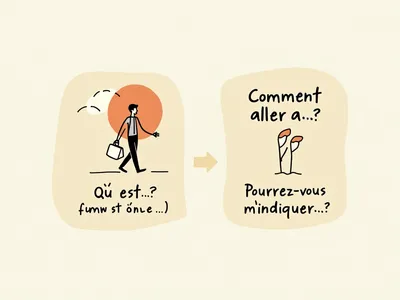
What are some common phrases to ask for directions in French
Here are some common phrases to ask for directions in French:
- Excusez-moi, pourriez-vous m’aider? (Excuse me, could you help me?)
- Où est…? (Where is…?)
- Comment puis-je aller à…? (How can I get to…?)
- Pouvez-vous me montrer sur la carte? (Can you show me on the map?)
- Je cherche… (I’m looking for…)
- Quelle est la direction pour…? (What is the direction for…?)
- Est-ce loin d’ici? (Is it far from here?)
- Y a-t-il un(e)… près d’ici? (Is there a… near here?)
- Pour aller à…, s’il vous plaît? (To go to…, please?)
- Pouvez-vous m’indiquer le chemin pour…? (Can you point me in the direction of…?)
Additional useful phrases:
- Pouvez-vous répéter, s’il vous plaît? (Can you repeat, please?)
- Je ne comprends pas. (I don’t understand.)
- Est-ce que c’est loin? (Is it far?)
- Combien de temps cela prend-il à pied? (How long does it take on foot?)
- Est-ce que je peux y aller en bus/métro? (Can I get there by bus/metro?)
- Je suis perdu(e). (I’m lost.)
Starting politely is important in French, so a friendly “Bonjour” or “Excusez-moi” helps before asking for directions.
Key Points on Using Direction Phrases in French
When asking for directions in French, politeness forms the foundation of any interaction. Using formal forms such as vous rather than tu is customary when speaking to strangers. The conditional tense, as in pourriez-vous (could you), sounds more polite and is preferred over the more direct imperative forms.
French-speaking people often respond with detailed instructions that include references to landmarks, modes of transport, or approximate distances. This means the listener benefits greatly from knowing follow-up questions, such as Est-ce que je peux y aller à pied? (Can I go there on foot?) or Y a-t-il un arrêt de bus/métro proche? (Is there a bus/metro stop nearby?)
Pronunciation tips: Excusez-moi is pronounced [ehk-skew-zay mwa]; the polite plural vous is pronounced [voo]—always a soft, rounded vowel sound—while tu ([ty]) is more intimate and usually avoided when asking strangers.
Exploring Structure: How to Formulate Your Questions
Asking Où est…? (Where is…?) is the simplest way to inquire about a location. For example:
- Où est la gare? (Where is the train station?)
Combining it with s’il vous plaît (please) enhances politeness:
- Où est la gare, s’il vous plaît?
For more detailed directions, Comment puis-je aller à…? (How can I get to…?) invites the listener to explain the route rather than just point it out.
Using je cherche (I am looking for) is a straightforward way to express your goal:
- Je cherche la bibliothèque. (I am looking for the library.)
Quelle est la direction pour…? (What is the direction for…?) is a slightly more formal question, asking for orientation rather than a specific place:
- Quelle est la direction pour le centre-ville? (What is the direction to the city center?)
Cultural Context When Asking for Directions in France
In France, strangers are generally willing to help, but brevity and courtesy matter. Starting with Bonjour or Bonsoir (good evening) before proceeding to your question is considered polite. Unlike some cultures, French speakers may not rush into assistance immediately without the initial greeting.
Additionally, in smaller towns and rural areas, locals might answer in regional accents or use local terms for locations (e.g., la mairie for town hall), which can be unfamiliar to learners but adds cultural richness to conversations.
French people often describe directions using landmarks rather than street names, especially in historic or old-town areas where streets may be narrow or unnamed on smaller maps. For example:
- Tournez à gauche au café (Turn left at the café)
- Continuez tout droit jusqu’au pont (Continue straight ahead until the bridge)
Common Mistakes and How to Avoid Them
- Using tu instead of vous: When addressing strangers, always use vous to maintain politeness.
- Omitting polite expressions: Starting directly with Où est… or Je cherche… can seem abrupt. It’s better to precede these phrases with Bonjour or Excusez-moi.
- Mispronunciation of question words: French question words like où ([oo]) and comment ([koh-mahn]) are short and precise; elongating or mispronouncing them can cause confusion.
- Relying too much on literal translations: For example, the English phrase “Is it far?” translates best as Est-ce que c’est loin? rather than a word-for-word substitution which may not exist.
Step-by-Step Example: Asking for and Understanding Directions
-
Greet politely:
Bonjour, excusez-moi… (Hello, excuse me…) -
Ask your question:
Où est la station de métro? (Where is the metro station?) -
Request clarification if needed:
Pouvez-vous répéter, s’il vous plaît? (Can you repeat, please?) -
Ask about distance or means of transport:
Est-ce que c’est loin à pied? (Is it far on foot?) -
Confirm if you understood directions correctly:
Je dois tourner à droite au café? (I must turn right at the café?) -
Thank them:
Merci beaucoup! (Thank you very much!)
Additional Useful Vocabulary for Directions
- Le coin: the corner
- Le croisement: the intersection
- La rue: the street
- Le boulevard: the boulevard
- Le pont: the bridge
- Le feu rouge: the traffic light
- La station de métro: the metro station
- Le parking: the parking lot
Example phrase including vocabulary:
- Tournez à gauche au coin de la rue. (Turn left at the corner of the street.)
FAQ
Q: How do I ask if a place is open right now?
A: Est-ce que c’est ouvert maintenant? (Is it open now?)
Q: How can I ask if the directions are easy to follow?
A: C’est facile à trouver? (Is it easy to find?)
Q: What if I want to ask for help with public transport?
A: Use Est-ce que je peux prendre le bus ou le métro pour y aller? (Can I take the bus or metro to get there?)
Mastering common direction phrases in French is a practical way to boost conversational confidence. Practicing these with conversation partners or AI tutors enhances fluency by simulating real-life interactions, an essential step beyond passive learning methods.
References
-
How to Ask for Directions in French: Key Phrases for Students
-
Ask and Give Directions in French: Feel like a Native Speaker