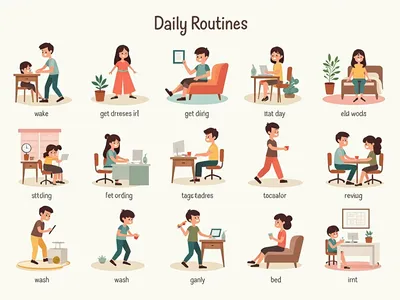
What are some essential verbs for describing daily routines
Some essential verbs for describing daily routines include:
- Wake up: to open your eyes and become conscious after sleep.
- Get ready: to prepare yourself for the day, including activities like brushing teeth and getting dressed.
- Have breakfast/lunch/dinner: to eat meals during the day.
- Go to work/school: to travel to your place of employment or education.
- Work/study: to engage in tasks or learning.
- Exercise: to perform physical activities to stay fit.
- Relax: to take a break and unwind.
- Go to bed: to get into bed and prepare to sleep.
- Get up: to stand up after being in bed.
- Brush (teeth/hair): to clean teeth or hair.
- Take a shower: to wash yourself.
- Cook dinner: to prepare food.
- Finish work/classes: to complete daily tasks or lessons.
These verbs are commonly used in the present simple tense to describe habitual daily actions and can be combined with time phrases and linking words for clarity and flow. 1, 2, 3, 4, 5
Understanding the Usage of Essential Daily Routine Verbs
Using these verbs correctly involves more than just knowing their meanings. For effective communication, especially in a new language, it’s important to understand how to conjugate these verbs, their common collocations (words that typically go together), and their position in typical sentences about daily routines.
For example, since we describe habitual actions, these verbs are most often used in the present simple tense:
- I wake up at 7 a.m. every day.
- She goes to work by bus.
- They have breakfast before leaving the house.
Note the verb “go” changes to “goes” with the third person singular subject, an important grammar rule in languages like English and German (gehen → geht).
Combining Verbs with Time Expressions and Linking Words
To make descriptions more natural and fluent, verbs of daily routine frequently pair with time phrases and linking words such as:
- Time expressions: in the morning, after work, at night, every day, usually, sometimes.
- Linking words: then, after that, before, while, and, but.
Example sentences:
- I wake up early in the morning, then I take a shower and get ready for work.
- She usually has breakfast at 8 a.m., but sometimes she skips it when she is rushed.
- After I finish work, I exercise for 30 minutes before I relax in the evening.
These small additions enhance the flow of your speech or writing and give a clearer picture of your routine.
Common Mistakes and Pitfalls to Avoid
Learners sometimes struggle with daily routine verbs because of common pitfalls:
-
Misuse of verb tenses: Describing daily routines requires the present simple tense, not the present continuous (e.g., “I am waking up at 7 a.m.” sounds odd unless emphasizing a temporary or unusual situation).
-
Incorrect verb forms with subjects: Third-person singular requires special verb forms (he/she/it goes, not go).
-
Omitting particles or prepositions: For phrasal verbs like “get up” or “go to work,” leaving out words changes the meaning.
-
Using verbs too literally: Some verbs don’t translate directly in contextual meaning. For example, “take a shower” isn’t just about physically taking; it means to wash oneself, so equivalent phrases in target languages might differ.
Expanding Your Vocabulary: Related Verbs and Expressions
Beyond these basics, a richer description of daily life includes verbs related to habits and self-care:
- Prepare (food, documents, presentations)
- Commute (to travel between home and work/school)
- Meet (with colleagues, friends)
- Read (books, news)
- Watch (TV, videos)
- Clean (the house, dishes)
- Sleep (the actual act of sleeping)
Including these verbs allows more nuanced descriptions of routines:
- After I finish work, I meet friends for dinner.
- She cleans her apartment every Saturday morning.
- I watch the news while having breakfast.
Step-by-Step Guidance on Describing Your Daily Routine
A practical approach to talk about daily activities is to organize your routine into clear stages:
-
Morning routine: wake up, get up, take a shower, brush teeth/hair, have breakfast, get ready.
-
Daytime activities: go to work, study, work, have lunch, commute.
-
Afternoon/evening: finish work/classes, exercise, cook dinner, relax.
-
Night routine: brush teeth, go to bed, sleep.
Using this sequence helps maintain logical, easy-to-follow narratives.
Tips for Practicing Daily Routine Verbs in Different Languages
Since this site’s content targets multiple languages, awareness of language-specific verb usage is helpful:
-
German: Many daily routine verbs require separable prefixes (e.g., “aufstehen” means “get up,” where “auf” separates in present tense: Ich stehe um 7 Uhr auf).
-
Spanish and Italian: Regular verbs follow predictable conjugation patterns; reflexive verbs (levantarse = “get up”) are common for daily routine actions.
-
French: Frequent use of reflexive verbs (se réveiller = “wake up”) and pronominal verbs; verbs must agree with subject and tense.
-
Russian and Ukrainian: Aspect (imperfective vs. perfective) matters for describing habitual vs. completed actions.
-
Chinese and Japanese: Often lack tense inflection; rely on adverbs or particles. Verbs like 起床 (qǐchuáng) and 起きる (okiru) imply “get up.”
Mastering these nuances improves both fluency and accuracy.
Summary
Essential verbs for describing daily routines serve as the foundation for clear communication about everyday life. Understanding their meanings, grammatical forms, and contextual usage, combined with time expressions and linking words, allows for natural, fluent descriptions. Expanding vocabulary and recognizing language-specific features further enriches language learning for polyglots tackling daily routines.